HORSES, PEOPLE, TIME
the film had a première at la Gaieté Lyrique, Paris, 02/12/14
presented by the Rencontres Internationales festival
--------------------------
PRESENT TENSE
Kalmar Kunstmuseum, Sweden
curators: Marianna Garin, Andres Kurg
15/11 - 15/02 2015
Daria Melnikova (LAT)
Egle Budvytyte (LTU)
Eleonore de Montesquiou (EST)
Flo Kasearu / Andra Aaloe / Aet Ader (Architect collective B210), Grete Soosalu (Architect collective B210) (EST)
Johnson and Johnson (EST)
Jouzas Laivys (LTU)
Jüri Okas (EST)
Kostas Bogdanas (LTU)
Marge Monko (EST)
Ronja Yu (SE)
-------------------------
CARNATIONS AND TULIPS
the film had a première at la Gaieté Lyrique, Paris, 02/12/14
presented by the Rencontres Internationales festival
--------------------------
PRESENT TENSE
Kalmar Kunstmuseum, Sweden
curators: Marianna Garin, Andres Kurg
15/11 - 15/02 2015
Representations of the Baltic cities – Tallinn, Riga and Vilnius – have in the recent past concentrated on their post-socialist transformations: overcoming Soviet heritage and negotiating changes of the new capitalist modernity. Now, twenty years after the arrival of independence, after joining the European Union and free market economies, other keywords and processes have come to the forefront: managing post-industrial changes, reappearing social differentiations and the precariousness of global economic cycles, and more recently, anxiety over one’s geopolitical position.
Present Tense investigates the role of critical artistic practices vis-á-vis these changing societies and spaces. On the one hand there still exists a distrust of collective means of opposition, carrying a stigma of Soviet propaganda strategies, and on the other hand artistic work is met with the rhetoric of creative economies and entrepreneurialism, that translates oppositional gestures into productive ones. The exhibition focuses on urban and public spaces, where the conflicts and contrasts are made visible but where also interventions to the existing order of things could gain wider significance. Also – have we now moved on to a new point in history? The fact that Soviet society which was directed at constructing a different future, merely spawned an aftermath that has to deal with leftover ruins, seems to suggest that.
By engaging also works from the 1970s, Present Tense aims to build a different kind of genealogy for these interventions in the present, showing how several young artists in the Baltics took an active stance towards the changing urban environment already in the early 1970s.
Along a row of video works, interventions, sculptures, actions and performances integrated in the exhibition display is a reading corner, where diverse material such as documentation and publications introduces the audience to the work of urban activists in the Baltic countries, that often have borrowed artistic strategies for community organisation and activation.
Some works presented here could even mirror another part of the Baltic – namely the city of Kalmar where this exhibition takes place. Also this city is experiencing a post industrial recession, with many local industries in decline while social costs soar, resulting in a decrease in the population. Kalmar is no stranger to radical ideas, which can be seen in Ronja Yu’s film “The Chinese Are Coming”, also featured in the exhibition.
Egle Budvytyte (LTU)
Eleonore de Montesquiou (EST)
Flo Kasearu / Andra Aaloe / Aet Ader (Architect collective B210), Grete Soosalu (Architect collective B210) (EST)
Johnson and Johnson (EST)
Jouzas Laivys (LTU)
Jüri Okas (EST)
Kostas Bogdanas (LTU)
Marge Monko (EST)
Ronja Yu (SE)
-------------------------
CARNATIONS AND TULIPS
Fuga gallery, Budapest, Hungary
curated by Rebeka Põldsam, Center for Contemporary Arts, Estonia
2014
curated by Rebeka Põldsam, Center for Contemporary Arts, Estonia
2014
The exhibition Carnations and Tulips is
looking at Estonian women of today who grew up in the Soviet Union, witnessed
the collapse of Soviet empire and after that the processes of re-gaining
independence. These women have had to embrace the constant crisis of capitalist
neoliberal state which is rather different from the one known from the
childhood. These women have experienced social hardships with dignity and
without complaining, which makes many of them somewhat stiff and
incomprehensible, however, they are often the stable strong stick to lean on
for the rest of the society.
The main focus at this exhibition is on the
private sphere of contemporary women: their memories, ideals and principles,
existential issues according to their individual lifelines. In the videopiece Woman
by Eléonore de Montesquiou, Olga tells the background story of the exhibition
how in the Soviet Union a so-called superemancipation took place, where
women and men worked equally, nevertheless, women got less paid and had to take
care of the family while men just drank till death. Possibly, as a result of such
a society, women nowadays simply want to be women – fragile, unambititious,
pretty, taken care of my men. At the same time, all this is in contradiction to
the gender equality rhetorics based on Western logic which is not competent in
Eastern Europe since here women entered the work market couple of decades
earlier than in Germany or France. Despite dispirited and melancholic tone in
her voice, Olga is an emancipated woman who knows well her strengths and
weaknesses, she knows how to express her opinion and be true to herself.
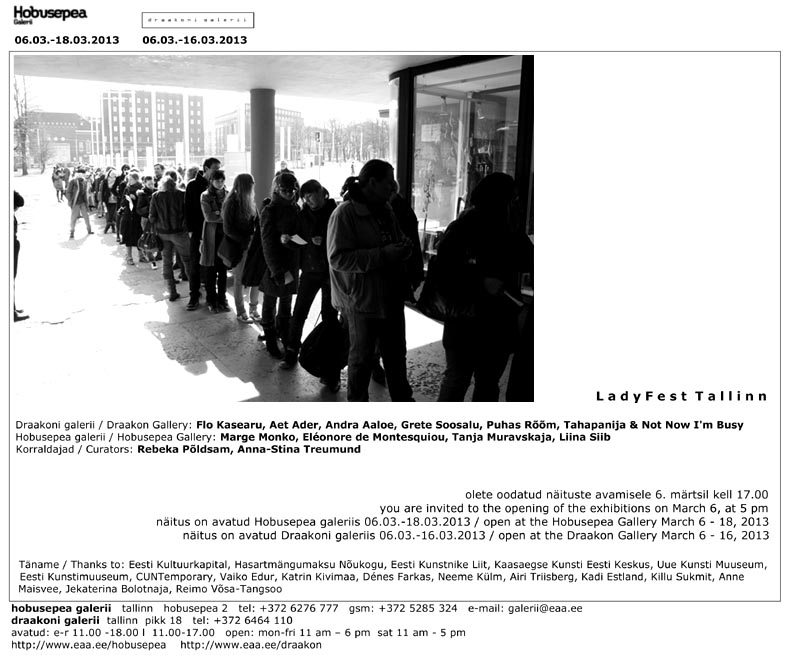
artists: Marge Monko, Eléonore de Montesquiou, Tatjana Muravskaja, Liina Siib
--------------------------
NAPOLEON
Abel Gance F 1927 312‘
18. November, 19.15h im Kino Arsenal
Filmmakers’ Choice präsentiert von Eléonore de Montesquiou
„Das Kino ist eine Flamme, ein Licht, man muss begeistern … Napoléon ist Prometheus. Es handelt sich in dem Film nicht um Moral oder Politik, sondern um Kunst“ schrieb Abel Gance 1927 bei der ersten Vorstellung von NAPOLEON (F 1927). Der Film sollte ein lebendiges Zeichen für die Zukunft sein. „Aus dem Zuschauer einen Akteur machen, ihn in die Handlung einbringen, ihn den Rhythmen der Bilder aussetzen“ war Gances Ziel, wofür er eine Sprache des Kinos erfunden hat: Überlagerung der Bilder, Polyvision mit dreifacher Leinwand waren u.a. Mittel, dieses Ziel zu erreichen. 1925 hat er angefangen, NAPOLEON zu drehen. Unfertig, mehrmals gekürzt und weiter bearbeitet, hat der Film Gance sein Leben lang begleitet. (Eléonore de Montesquiou)
Für weitere Informationen:
Christine Sievers | Presse- und Öffentlichkeitsarbeit
030 269 55 143 oder cs@arsenal-berlin.de | www.arsenal-berlin.de
Kino Arsenal 1 & 2 | Potsdamer Straße 2 | 10785 Berlin
Das Arsenal – Institut für Film und Videokunst wird gefördert durch den Beauftragten der Bundesregierung für Kultur und Medien.
-------------------------------
Et moi je vis seul dans cette grande baraque
curator: Jeanne Susplugas
une exposition du centre d’art contemporain Chapelle Saint-Jacques
à l’Abbaye de Bonnefont, à Proupiary
du 22 Juin au 15 Septembre 2013
Bonnefont – Saint-Jacques / Deux lieux patrimoniaux pour une exposition constituée d’oeuvres choisies dans la collection du Frac Midi-Pyrénées et d’oeuvres que nous confient les artistes, Eléonore de Montesquiou, David Coste, Jim Fauvet, et Bertrand Segonzac.
-------------------------
Côté court, Pantin
Côté court, Pantin
projection de Remember et Gazette
une proposition de Romana Schmalisch invitée par Côté court
Jeudi 13 Juin 2013, 20h00, au Ciné 104, dans le cadre du festival Côté court
Jeudi 13 Juin 2013, 20h00, au Ciné 104, dans le cadre du festival Côté court
Le
festival Côté court offre une carte blanche à Romana Schmalisch.
Construite en lien avec le projet qu'elle mène aux Laboratoires,
l'artiste Romana Schmalisch présentera une séance intitulée "Le cinéma
n'a pas de patrie",
avec des films de des films d'Art Laboratory Yerevan, Eléonore de
Montesquiou, Robert Schlicht/Romana Schmalisch, ainsi qu'une archive du
fonds filmique du Parti Communiste français.
"Le cinéma n'a pas de patrie"
«Témoin
de l’histoire, le cinéma reflète les moments historiques, les conflits,
les changements que connaît la société et, dans un même mouvement, sa
propre historicité. Les films de ce programme sont autant de regards
posés sur l’Union Soviétique ou la Russie, sur ses structures, ses
conflits et les tournants de son histoire - des regards posés depuis
l’extérieur de ce pays. Ils se réfèrent à des
moments historiques mais par là même énoncent également un point de vue
propre et actuel. En tant que producteurs de cette historiographie, les
réalisateurs prennent position par rapport aux événements
politiques et contribuent ainsi activement à l’écriture de l’histoire
depuis leur propre perspective. Le programme réunit des films se
référant à différentes périodes et trace ainsi des liens entre les
années 1930 et aujourd’hui, permettant une relecture contemporaine de
l’histoire passée. En dépassant les distances spatiales, nationales
ainsi que temporelles grâce au médium cinématographique, les films
superposent les projections de différents modèles de société, analysant
et éclairant les conditions politiques actuelles.»
Politicizing the toasts - Art Laboratory Yerevan, 2012 - 03 min.
Politicizing the toasts 2 - Art Laboratory Yerevan, 2012 - 02 min.
Politicizing poetry - Art Laboratory Yerevan, 2012 - 02 min.
Remember - Eléonore de Montesquiou, 2011 - 10 min
Gazette - Eléonore de Montesquiou, 2009 - 04 min.
L'Exposition internationale des Arts et Techniques - Anonyme, 1937 - 21 min.
Preliminaries - Robert Schlicht , Romana Schmalisch, 2011 - 48 min.
Preliminaries - Robert Schlicht , Romana Schmalisch, 2011 - 48 min.